

Cara Fellow Amani Ahmed on Palestinian resilience, exceeding limits, and rebuilding Gaza’s universities
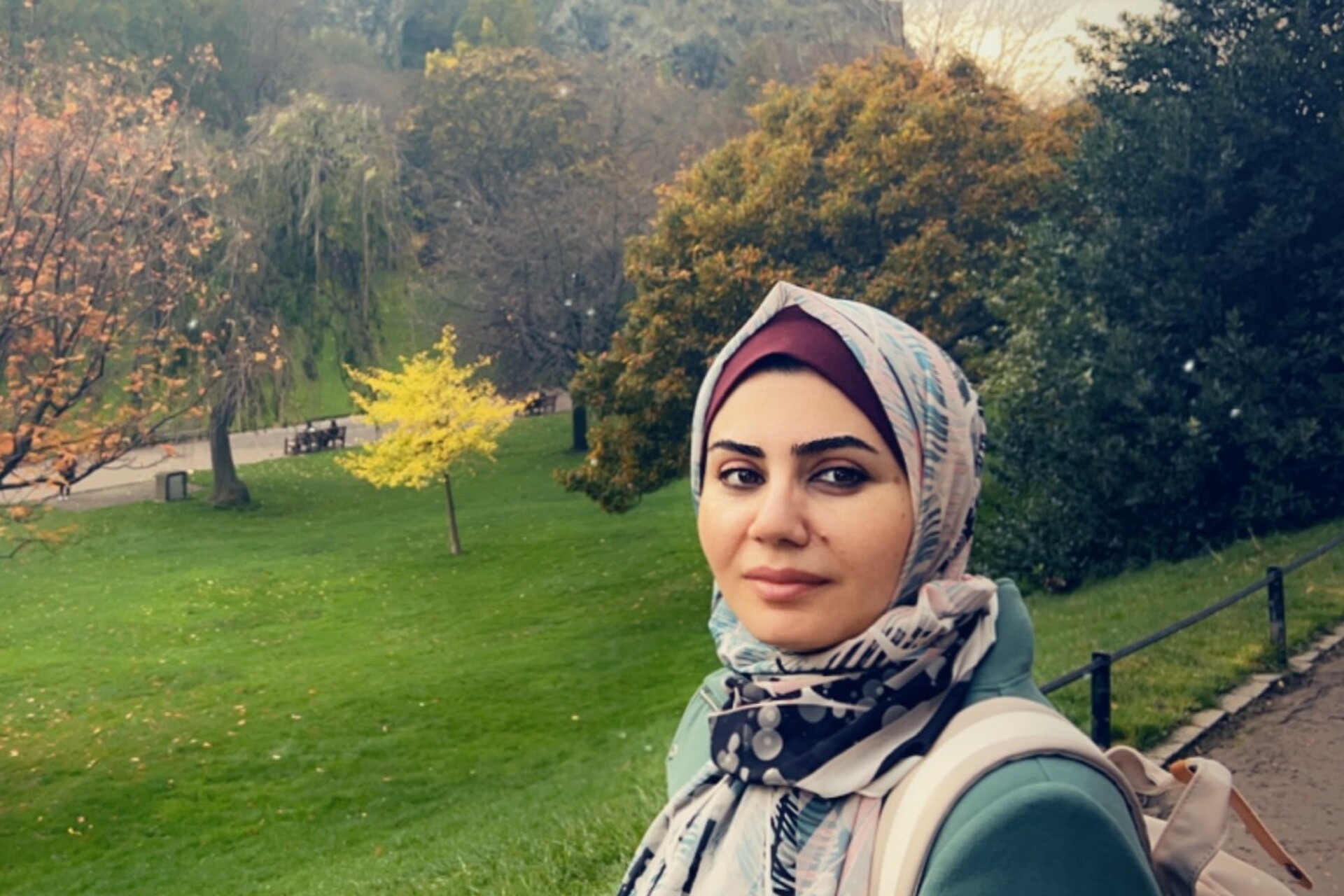
We speak to Palestinian Fellow Amani Ahmed about resilience, the importance of family and community, and why universities in Gaza need more institutional support to keep the sector alive. Amani is currently taking her PhD in Business Administration and Management at the University of Edinburgh. She was previously a lecturer and head of the International Relations Department at the Islamic University of Gaza, and was studying in the UK when war struck Gaza in 2023.
You have over 20 years of experience in higher education. Could you share more about your work and how you started in the academe?
I was one of the best students in my undergraduate class in electrical engineering in the Islamic University of Gaza so I started to work as a teacher’s assistant after. I continued to work at the University and eventually initiated the International Relations Department, which is responsible for managing partnerships and international projects at the university. We started our work with only three partnerships and now we have more than 300 partners. But I continue to teach because I love teaching and like to interact with the students.
Can you tell us about your research at the moment?
My research is focused on how women entrepreneurs are supporting the resilience of the entrepreneurial ecosystem in conflict contexts like in Palestine. I'm focusing on the woman experience and how they are really co-creating the entrepreneurial ecosystem in partnership with other actors in Palestine.
Theories that are drawn from the understanding of Western and developed countries really contradict that the requirements to establish an entrepreneurial ecosystems are in Palestine—but how do they have this kind of entrepreneurial ecosystem? There are women who are highly educated and highly motivated, who have established a fixed career but choose to shift to entrepreneurship. So my focus was on them and how this power dynamic is happening inside the entrepreneurial ecosystem.
Much of your work is focused on women and women's empowerment. How do you develop this interest?
I was a student one day and continue to be a student, I saw how women students have potential and dreams but sometimes lack self-confidence. The community is very supportive of women’s education, but I would say [women] need to know that they can exceed limits.
With my former professor, we initiated the Women Studies Centre at the Islamic University of Gaza, which was actually the first of its kind at a university in the Gaza Strip. We try to really let people understand the point of gender equality and women's empowerment, and not only focus on the Western definition of empowerment. And when it comes from a university it will have a multiple effect and impact because it's not only impacting the students, it also impact the community.
Could you also tell us about your experience being an academic in the UK, while there was conflict back home where your family was based.
It’s not easy at all. I went through different phases of being an academic in the UK. In my second year, the war started, and I felt like I was stuck here whereas my family, my children, all of my loved ones, are just in Gaza.
But I have a lot of people who supported me. The university supported me very well, my supervisor is really very helpful, very compassionate. And when I started collecting data and talking with women from the West Bank, seeing and learning more about their experiences gave me more energy and more support. When the family joined me with the support of Cara, a lot of things changed. I felt more relaxed because I have my children and my husband here. It gave me more space to continue working and collecting the data. And I felt that I need to speak about the experience of those the whom I met. Because at some point it's not only a PhD, but also it's about sharing the stories of those people— my people— and what they are going through.
What does the research mean to you and what do you want to see from it?
I would say that to let the world knows how resilient the Palestinian community is. How sometimes even within their situations and in a situation that contradicts all norms, we still see the human power exceed limits and exceed what really other people would anticipate. This is what I saw and also what I'd like to see it reflected in the theory of entrepreneurship. And also the policy of how to intervene in such situations and how it is important to hear the voices from the locals because they are the ones who understand the needs rather than imposing them from top-down.
Speaking of resilience, you are currently doing work to support the resilience of universities and students in Gaza
I work with the several universities in a scheme that has managed to send students from and outside Gaza for exchange programs with different countries. After the destruction of universities, what I'm seeing is more a responsibility as a Palestinian rather than just being someone with a scholarship and a full time student.
A few months ago I began sharing my experience with postgraduate scholarships to support Palestinian graduates who are eager to continue their studies. The response has been overwhelmingly positive from many young people across the Palestinian community— inside and outside the Strip. It reflects not only the need for accessible information but also the determination of Palestinian graduates to overcome barriers and pursue advanced education, even under the most challenging circumstances.
I’ve also been pushing back against the narrative that the universities in Gaza have been destroyed. Through partnerships, I was the first to write a report about what is really happening with the higher education sector in Palestine, especially in the Gaza Strip.
We don't want the people to think that we are just people who are living in tents and trying to survive. It's not the real story and real situation. There is a lot of higher education, a lot of professors. The universities have resumed the educational process through online platforms and are participating in different avenues to speak about what is happening.
What happened was the targeting of universities to destroy the institutions, but the institutions are not only buildings, institutions are institutions by their own, by the teachers, by the students, by the system. So if we have all of this, even if we don't have the building, then yes this is a very big challenge, but this doesn't mean that we don't have institutions anymore. [It’s not enough to only] take all the students from Gaza and teach them online because this will undermine the agency of the institutions. We need to be giving back the agency to them instead of taking out the agency of the Palestinian people.
You are doing all these while working on your PhD. How have you been able to cope and manage everything that's been going on?
I rely on my wide experiences. What I'm doing is not really initiating the new wheel, it's just taking all and accumulating all my expertise these 20 years and now trying to push me in surrounding different directions. The second point that kept me working is the field of responsibility and also the support I'm getting.
Having the family with me is just a relief. I don't think that I will be able to do a lot of these things without having the children with me.
Also because I have this scholarship by the University of Edinburgh Business School. If you have secured your financial situation and you have the empathy and support from the academic community in your university, and the friends you have the family with you. This will give you the strength and power to do a lot of things. This is the time to pay back to the community.
Each year, Cara supports over a hundred at-risk academics who show exceptional talent, resilience, and commitment to their field despite adversity. Our Cara Fellows series highlights the stories of these fellows and their contributions to science, learning, and higher education.