

Belonging for a Displaced Scholar
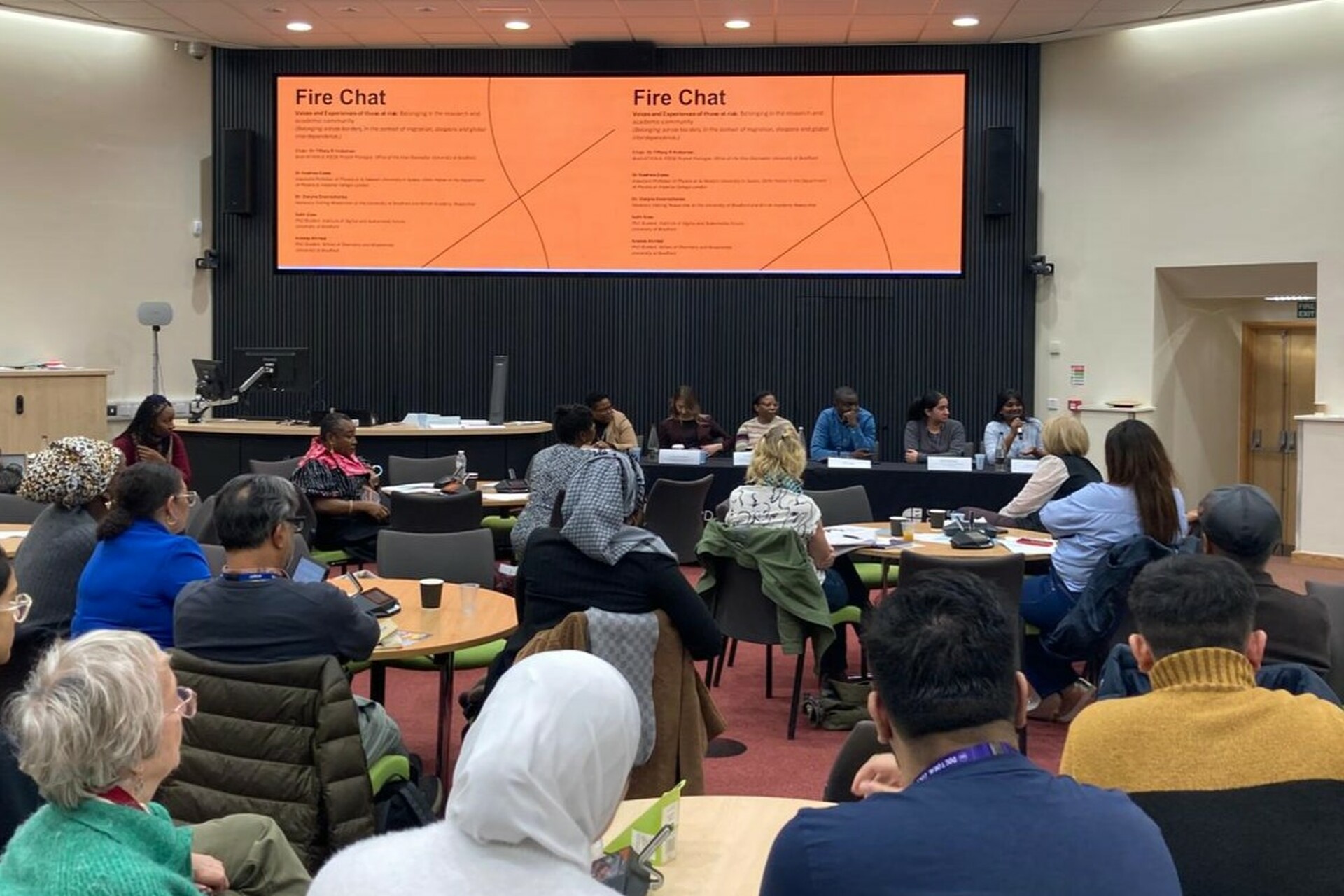
Dr. Nashwa Eassa is an Associate Professor of Physics at Al Neelain University in Sudan and a Cara Fellow in the Department of Physics at Imperial College London. On December 9, she spoke as a panel member at the Rosa Parks Symposium at the University of Bradford, themed “Belonging in a Changing World: Does my belonging threaten your belonging?” Her reflections explore what belonging means for scholars forced into displacement by war and instability.
When I was invited to the Rosa Parks Symposium, I had not consciously reflected on the question of belonging. It was not something I allowed myself to ask. As a forcibly displaced scholar, my attention was directed elsewhere, toward survival rather than belonging. Safety came first, then continuity, then the urgent task of not disappearing academically or personally. Belonging felt distant in the face of immediate loss.
Still, I was deeply grateful to take part in the 21st Rosa Parks Symposium and to contribute to this essential conversation.
For years, my life revolved around a clear mission, building world class scientific research in Sudan despite limited resources. I believed then, and still believe, that science is inseparable from society. Physics, for me, was a tool for development, for educating students, and for contributing to a country’s economic and intellectual future.
Then one morning, everything changed.
War exploded. Universities were destroyed. Laboratories disappeared. Students were displaced. Colleagues scattered across borders. Like millions of Sudanese, I was forced to leave my home, in search of safety.
Arriving in a new academic environment, I carried two truths at once, relief at being safe and grief for everything left behind. I entered laboratories with my scientific expertise intact, accompanied by an unspoken question. Would I be seen first as a scientist, or as a displaced person?
Belonging, I learned, can be rebuilt, but only through intentional effort. I encountered colleagues who opened their laboratories without hesitation. Institutions like Cara that refused to let academic lives vanish quietly. A host supervisor and research group who treated me not as a case, a statistic, or a story, but as a peer.
At the same time, there are moments when the limits of belonging become visible. Restricted access to opportunities, temporary labels, and the persistent sense that one’s presence is conditional. This is where the symposium’s question becomes painfully real. Does my belonging threaten your belonging?
I reject the idea that belonging is a competition. Scholars shaped by conflict bring resilience, adaptability, ethical urgency, and global perspective. Our presence does not weaken academic spaces. It expands them. Knowledge grows stronger when shaped by multiple realities.
Belonging is also a process of reconnection and rediscovery. For displaced scholars, it often begins internally, through rebuilding an identity fractured by loss, before it can be affirmed by institutions or systems.
For me, real belonging is simple. It is the moment when I no longer need to justify my presence in the room. When I can build a future again through my science, contribute meaningfully to knowledge.
I close with the words of Rosa Parks, which remind us why these conversations matter.
“I believe we are here on the planet Earth to live, grow up and do what we can to make this world a better place for all people to enjoy freedom.”