

READ: Transforming Disruption into Contribution - A speech by Cara Fellow Dr. Alaa Zam
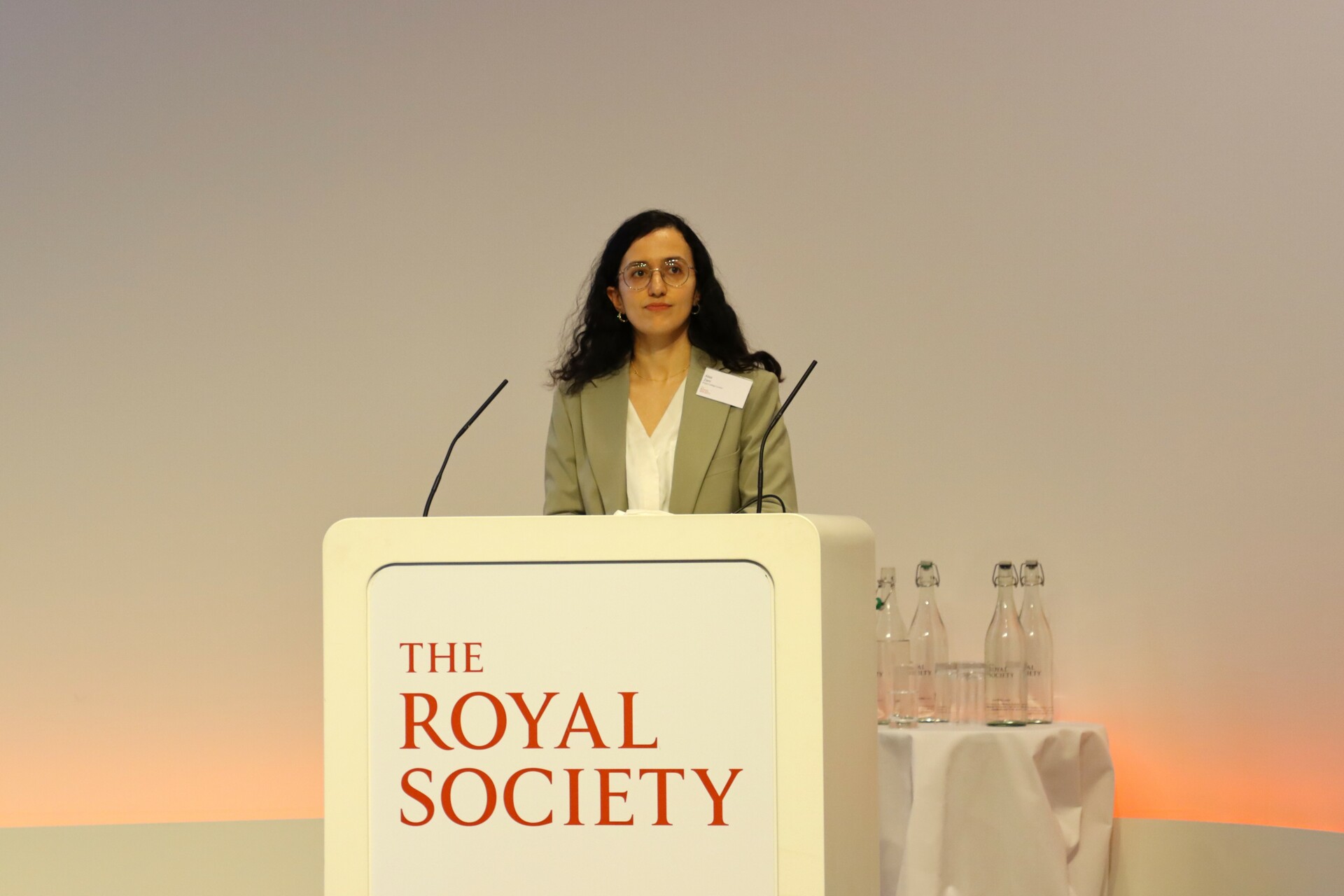
Dr. Alaa Zam is a Syrian Cara Fellow and a researcher at King's College London whose work focuses on cancer nanomedicine. Last 5 March 2026, she spoke at the Cara and Royal Society Science and Civilisation Lecture about her journey as a scientist, individual, and Cara Fellow. Read the full text of her speech below:
Good evening everyone,
It is a true honour to stand here today at the Royal Society, surrounded by Cara Fellows, partners, supporters, and friends of science.
My name is Alaa Zam. I am a Cara Fellow and a researcher in Pharmaceutical Sciences at King’s College London, where I recently defended my PhD in cancer nanomedicine.
My journey into research did not begin in stability. Growing up and beginning my academic path in Syria meant witnessing how quickly conflict can disrupt not only lives, but institutions — universities close, laboratories lose resources, mentorship is interrupted, and long-term scientific ambition becomes uncertain. When the environment around you is fragile, the idea of building a research career can feel almost out of reach.
There were moments when continuing in academia seemed impossible.
At that critical point, Cara opened a door of hope.
Cara’s support did more than enable relocation. It restored continuity. It provided stability in a period defined by instability. It allowed me to focus not on survival, but on science. And perhaps most importantly, it offered a sense of belonging — the reassurance that my potential as a researcher mattered.
With that support, I was able to pursue research on glioblastoma, one of the most aggressive and treatment-resistant forms of brain cancer. My work focused on developing lipid nanoparticle systems capable of delivering gene-based immunotherapies directly into the tumour microenvironment — an approach designed to overcome the profound immune suppression that limits current treatments.
Scientific research is often described in terms of data and outcomes, but behind every dataset is persistence — years of optimisation, failed experiments, learning curves, and resilience. For me, resilience was not only scientific; it was personal.
Earlier this year, I successfully defended my PhD thesis. Standing in my viva, I carried with me not only the scientific results of my work, but the journey that made it possible — the support networks, the mentors, and Cara’s belief at a time when belief changed everything.
Today, I am continuing this research as a postdoctoral fellow, having secured competitive funding from The Brain Tumour Charity to expand and translate these gene-based immunotherapy strategies. This funding allows me to refine innovative drug delivery platforms with the goal of bringing laboratory discoveries closer to clinical impact.
To me, this represents something deeply meaningful: continuity. The ability not only to start again, but to progress. The opportunity to transform disruption into contribution.
My story is only one among many Cara Fellows. And it is a reminder that when displaced researchers are supported, they do not simply rebuild their lives — they strengthen the scientific community. They bring diverse perspectives, resilience, and determination. They contribute to innovation. They mentor students. They publish research. They win grants. They give back.
Cara does not only protect individual scholars. It protects knowledge, scientific progress, and the shared future that research serves.
To everyone here who supports Cara — thank you. Your commitment transforms uncertainty into opportunity, instability into achievement, and hope into measurable impact.
I am standing here today — as a scientist, a postdoctoral researcher, and a Cara Fellow — because of that belief.
Thank you.